The Islamic Manuscript Tradition by Christiane Gruber
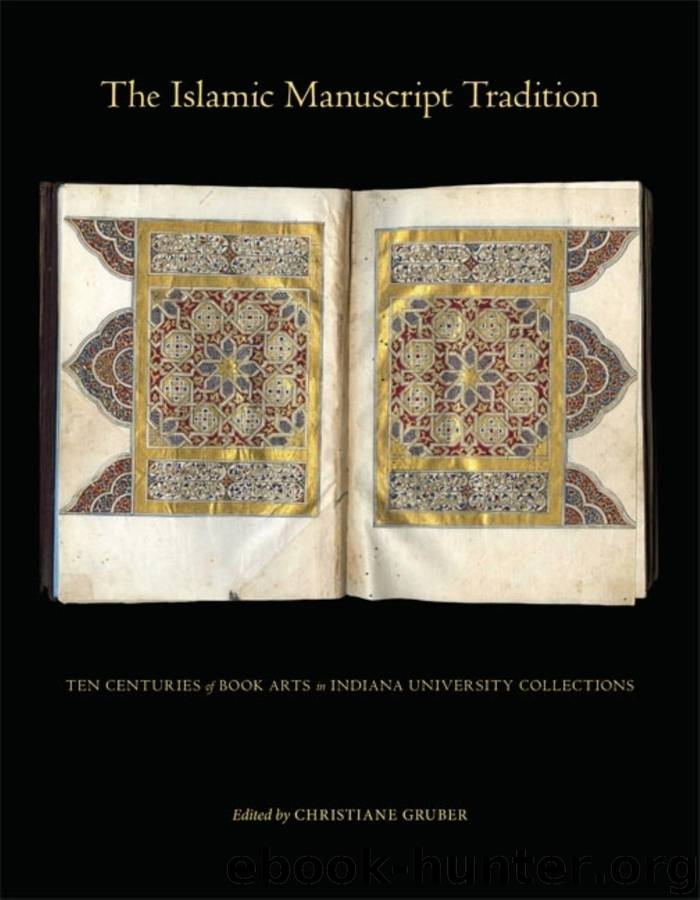
Author:Christiane Gruber
Language: eng
Format: epub
Publisher: Indiana University Press
Published: 2010-04-07T04:00:00+00:00
5
İbrahim Müteferrika and the Age of the Printed Manuscript
YASEMİN GENCER
İbrahim Müteferrika (ca. 1674–1745), an Ottoman imperial court steward, founded the first officially sanctioned Ottoman Turkish printing press in Istanbul in 1727.1 Active under his supervision between the years of 1729 and 1742, the press produced seventeen works in twenty-two volumes. Müteferrika’s press printed between five hundred and twelve hundred copies of each book—this output of 12,200–13,700 printed books2 was a relatively small yield for a printing press of the eighteenth century.3
Following several years of inactivity, the press fell into disuse indefinitely after Müteferrika’s death in 1745 but was used once again in 1756 by his successors, İbrahim Efendi and Ahmed Efendi,4 to issue the second edition of an Arabic-Turkish dictionary, Lugat-ı Vankulu, first published in 1729. After this time, the printing press was once again abandoned until it was bought from Müteferrika’s heirs by two court secretaries—Vak’anüvis Ahmed Vasıf Efendi and Beylikçi Raşid Efendi—in 1783–1784, at which time it was used to print six more titles.5
The Lilly Library at Indiana University, Bloomington, is the only repository in North America to house the complete collection of printed books produced by İbrahim Müteferrika’s press during his lifetime.6 The Lilly also owns a copy of the two-volume second edition of the Lugat-ı Vankulu (1756), as well as two books printed in 1783–1784. All volumes were purchased in 1976 from the estate of William Edward David Allen (1901–1973) of Waterford, Ireland.7 The library’s holdings thus provide a fitting opportunity to examine İbrahim Müteferrika and his press both during and after his lifetime, a period of rapid change and innovation in the Ottoman Empire.
The Müteferrika press was preceded by a number of presses established in Istanbul by non-Muslim Ottoman subjects. The very first printing house was established in Istanbul in 1493 by two Jewish brothers, David and Samuel ibn Nahmias, and was permitted to produce works in Hebrew.8 The Nahmias press was followed by many other presses run by ethnic and religious minorities, principally Armenians and Greeks, in other major cities of the empire.9 Despite such precedents, the Müteferrika press holds a significant place in the history of printing for Muslims: it was the first Islamic press in the Islamic world established with the approval of a Muslim ruler to produce works that catered primarily to a Muslim audience (using the local language, Turkish, and printed in Arabic script) and, more often than not, written from a Muslim author’s perspective.10 The Islamic world—in which book arts were deeply immersed in the traditions of the written word, calligraphy, and the aesthetics of the Arabic script—was unhurried in adopting the technology of printing, lagging three centuries behind Europe.11 The Müteferrika press thus was by no means the first printing press established in Ottoman lands; rather, it was the first to receive royal sanction to produce Islamic printed works.12
The products of the Müteferrika press embody the period of change between 1727 and 1745 in Ottoman Turkish printing technology. Müteferrika’s printed books in fact constitute the incunabula13 period of
Download
This site does not store any files on its server. We only index and link to content provided by other sites. Please contact the content providers to delete copyright contents if any and email us, we'll remove relevant links or contents immediately.
The Great Music City by Andrea Baker(33326)
Aircraft Design of WWII: A Sketchbook by Lockheed Aircraft Corporation(32376)
Call Me by Your Name by André Aciman(20697)
The Secret History by Donna Tartt(19436)
The Art of Boudoir Photography: How to Create Stunning Photographs of Women by Christa Meola(18745)
Shoot Sexy by Ryan Armbrust(17837)
Plagued by Fire by Paul Hendrickson(17523)
Portrait Mastery in Black & White: Learn the Signature Style of a Legendary Photographer by Tim Kelly(17094)
Adobe Camera Raw For Digital Photographers Only by Rob Sheppard(17073)
Photographically Speaking: A Deeper Look at Creating Stronger Images (Eva Spring's Library) by David duChemin(16787)
Ready Player One by Cline Ernest(15109)
Pimp by Iceberg Slim(14774)
Bombshells: Glamour Girls of a Lifetime by Sullivan Steve(14207)
The Goal (Off-Campus #4) by Elle Kennedy(13940)
Art Nude Photography Explained: How to Photograph and Understand Great Art Nude Images by Simon Walden(13138)
Kathy Andrews Collection by Kathy Andrews(12066)
The Priory of the Orange Tree by Samantha Shannon(9345)
The remains of the day by Kazuo Ishiguro(9191)
Thirteen Reasons Why by Jay Asher(9096)
